
Aluminum vs. Steel Sideboards for Flatbed Trucks: Which Lasts Longer and Saves More?
November 23, 2026
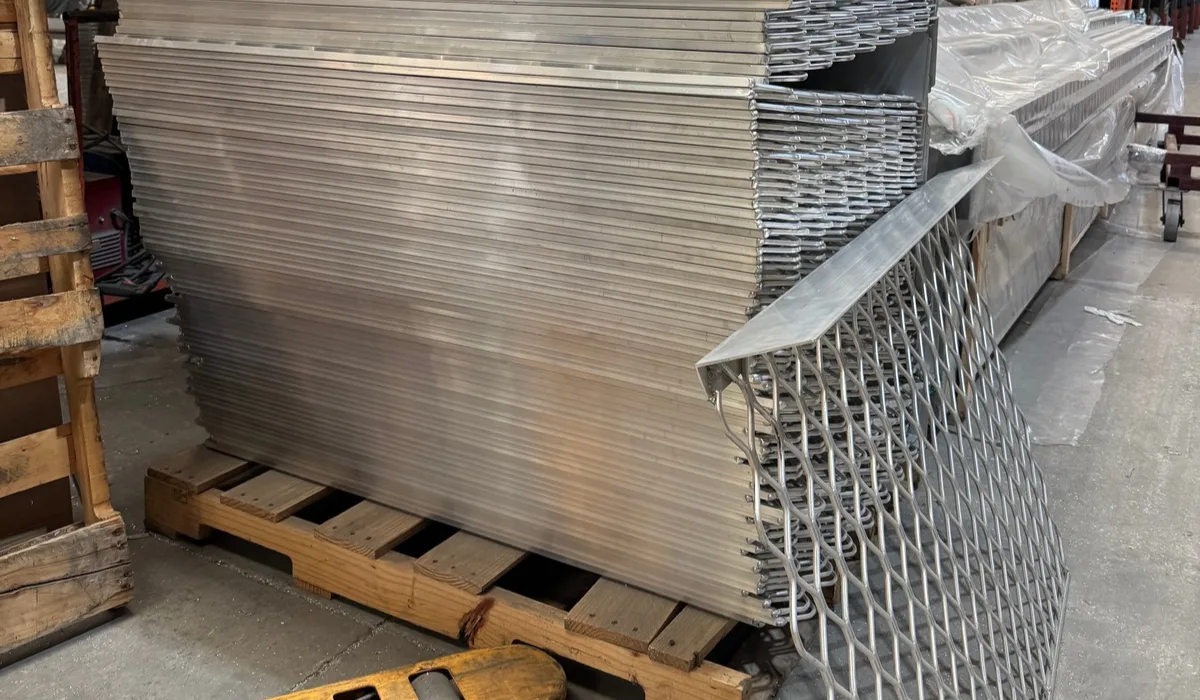
We build aluminum sideboards, so you should know where we stand. We also think the honest answer is more useful than a sales pitch. Aluminum and steel each win in some places. This guide shows where, so you can decide based on your trucks, your routes, and your loads.
The short answer
Aluminum usually wins on weight and rust. Steel usually wins on upfront price and is easier to weld at any repair shop. Which one lasts longer and saves more depends on your climate, how your panels get handled, and how well each panel is built.
Weight: Where Aluminum Has a Clear Edge
For the same volume of metal, aluminum weighs about one-third as much as steel. What that means for a finished panel depends on the design, because mesh pattern, frame angle, and gauge all change the final weight.
Weight matters most if you regularly run close to your maximum payload. Every pound you save on equipment is a pound of product you can haul. Lighter panels are also easier for drivers to lift and place, which adds up when they handle them every day. If you rarely get near your weight limits, the benefit is smaller.
One fleet owner who made the switch describes it this way:
"...we shed almost 600 lbs per truck switching from heavy solid steel racks to Unique's lightweight Unimesh sideboards."
Dave Jenkins, President, Jenkins Block Transport
Results vary with the number of panels per truck and the steel panels being replaced.
Key takeaway
Lighter panels help most when you run near your payload limit and when drivers handle panels often.
Rust and Corrosion
Steel rusts unless it is protected, usually with paint, powder coat, or galvanizing. Those coatings work well, but they chip and wear, and bare steel under a chipped coating starts to rust. Road salt, coastal air, and wet conditions speed this up.
Aluminum does not rust. It forms a thin oxide layer that protects the metal underneath. That said, aluminum can still corrode in some situations, most often where it touches a different metal, such as steel hardware, and stays wet. Good design and compatible hardware matter.
Common mistake
Assuming "does not rust" means "needs no inspection." Check any panel for damage and hardware condition, whatever it is made of.
Strength and Toughness
This is where steel's case is strongest. Steel is generally harder and more resistant to dents and dings. Aluminum is softer, which is why design matters so much. Great Dane's engineers, speaking about flatbed trailers, note that steel can be the better choice for extreme-duty work such as repeated forklift loading.
Panel design can make up much of the difference. For example, Unique Sideboards uses:
- 5/16" gauge Uni-Mesh aluminum for heavy-duty strength
- 1/2" U-channel edge finishing to protect the perimeter of the mesh
- A 1-1/2" x 5" angle with a radius outer edge. Concrete Products reported that this profile helps prevent chafing on nylon straps and spreads weight across multiple load units.
- Single-piece welded construction, so there are no bolted joints in the panel
- A Heavy-Pro option. The 48" Heavy-Pro adds doubled U-channel frame borders for the hardest-working applications.
If forklifts are part of your loading routine, the 72" x 30" panel is designed to deflect fork strikes.
What to avoid
Comparing aluminum and steel as if every panel of each material was equal. A well-designed aluminum panel can outperform a poorly built steel one, and the reverse is also true.
Repairs: Both Can Be Repaired, but Not at the Same Shops
Both materials can be repaired. The real difference is who can do it.
- Steel is easier to weld in the field, and almost any shop can do it.
- Aluminum needs a welder with aluminum experience. That is easy to find in some areas and harder in others. A repair that keeps a shop busy for days is real money lost.
Unique Sideboards panels are single-piece welded aluminum, so localized damage, such as a bent corner angle or a single cracked weld, can often be repaired by a qualified aluminum welder.
Key takeaway
Ask "who can repair this, and how fast?" before you buy, not after the first forklift strike.
Total Cost: How to Run the Numbers for Your Fleet
Steel panels typically cost less upfront. Aluminum typically costs more. The right comparison is cost over the time you keep the panels, not the price on the quote. Here is a simple way to do it.
Step 1: For each option, add up the purchase price for all the panels you need, plus freight.
Step 2: Estimate the repair cost per year and the days a truck sits out of service for repairs.
Step 3: Estimate how many years you expect the panels to last in your conditions. Use your own history if you have it.
Step 4: Divide the total (price plus repairs) by the years of service. That is your cost per year.
Step 5: If weight matters to you, add the value of the extra payload you can haul per trip, over the course of a year.
Side-by-Side Comparison
| Feature | Aluminum Uni-Mesh | Steel |
|---|---|---|
| Weight | Lighter (about one-third the weight per volume of metal) | Heavier |
| Rust | Does not rust, though it can corrode at contact with other metals | Rusts unless protected by coatings |
| Dent and impact resistance | Softer, so design matters | Generally tougher |
| Field repair | Needs a shop with aluminum welding experience | Easy to weld almost anywhere |
| Upfront cost | Typically higher | Typically lower |
| Cost over time | Depends on your climate, handling, and repairs | Depends on your climate, handling, and repairs |
What One Large Fleet Chose
In 2014, Concrete Products reported on Cemex's South Jacksonville Block facility in Florida, which used custom aluminum sideboards from our Sarasota shop (then operating as Unique Technology). A Cemex accounts manager for the Jacksonville district said safety was the main reason for choosing them and that the sideboards were mandatory company-wide. The facility also added custom 90-degree corner panels, which cut load time by 20 minutes compared with shrink-wrapping cubes.
This is one fleet's experience, not a controlled comparison with steel. But it shows what a large fleet looked at first: safety and loading time, not just price. Read the article: Aluminum sideboards shrink block loading, tie-down time.
Which Unique Sideboards Panel Fits Your Truck
If you decide aluminum is the right fit, here is how our lineup breaks down. Every order is custom quoted, so you can send your specs and fleet size and get a quote built around your trucks.
| Panel | Size | Good fit for |
|---|---|---|
| 48" x 30" Sideboard | 48" wide, 30" high | Standard brick cube loads |
| 48" x 36" Sideboard | 48" wide, 36" high | Taller flatbed masonry packages and stacked cargo |
| 48" Heavy-Pro | 48" wide, doubled U-channel borders | The hardest-working applications |
| 72" x 30" Sideboard | 72" wide, 30" high | More bed coverage per panel, designed to deflect fork strikes |
| 72" x 36" Sideboard | 72" wide, 36" high | Wide spans with taller loads |
| 96" Heavy-Duty | 96" wide | Our largest single-piece panel, for full-length coverage |
| Standard L-Corner | 90-degree interlocking corner | Closing the corners of the deck |
| Quick-Latch Corner | Corner gate with grab handles and spring latches | Corners where you need fast loading access |
Need something different? We build custom dimensions, cutouts that clear your tie-down points, and powder-coat fleet colors. See Custom Builds.
How to Decide
Step 1: Look at your routes. Heavy road salt, coastal air, or wet conditions favor aluminum.
Step 2: Look at your weight. If you often run close to maximum payload, aluminum's lower weight can help.
Step 3: Look at how panels get handled. If they take heavy forklift abuse every day, ask hard questions about edge design and gauge, whatever the material.
Step 4: Look at your repair options. If you do not have easy access to an aluminum welder, ask the supplier how repairs would work.
Step 5: Run the cost worksheet with real quotes.
Aluminum tends to fit well when you are salt-exposed, payload-conscious, and buying panels designed for heavy use. Steel can fit better when upfront cost is the main limit, repairs happen in the field, or handling is rough.
Frequently Asked Questions
Is aluminum strong enough for block and brick loads?
It depends on the design. Heavy gauge, a strong frame angle, and welded construction all matter. Unique Sideboards uses 5/16" gauge Uni-Mesh with welded construction for this kind of load, and the 48" Heavy-Pro adds doubled U-channel frame borders for the hardest-working applications.
Do aluminum sideboards rust?
No, aluminum does not rust. It can corrode in some conditions, especially where it contacts other metals, so check hardware and fit during routine inspections.
Are aluminum sideboards cheaper in the long run?
Not always. They usually cost more upfront, and the savings depend on your payload, climate, and repair costs. Use the worksheet above with your own numbers.
Can aluminum sideboards be repaired?
Yes, localized damage can often be repaired by a qualified aluminum welder. Panels with widespread mesh deformation or a buckled frame should be replaced.
Does the material decide whether sideboards meet DOT rules?
No. Federal cargo securement rules look at whether your securement system is strong enough and in sound condition, not at the material label. See our guide to DOT flatbed sideboard requirements.
Need sideboards for your fleet?
Tell us about your trucks and your loads. We will recommend the right panels and send a custom quote.