DOT Flatbed Sideboard Requirements: What Every Truck Driver and Fleet Manager Must Know
November 18, 2026
If you haul block, brick, or pavers on a flatbed, your sideboards are doing real work on every mile. They also show up in roadside inspections. This guide explains what the federal cargo securement rules say, what they mean for sideboards in plain terms, and what to check before every trip.
Key takeaway
There is no such thing as a federally "approved" sideboard. The rules look at whether your cargo is secured and whether your equipment is in sound condition. That is where your attention belongs.
Why Cargo Securement Rules Matter for Flatbed Operators
Cargo securement is one of the most common reasons a flatbed gets stopped, written up, or taken off the road. The consequences can include:
- Civil penalties against the driver or carrier. Amounts are adjusted for inflation each year.
- CSA points that affect a carrier's safety record.
- Out-of-service orders that stop a truck where it sits and delay the delivery.
For a fleet, this is a business continuity issue, not just a compliance one. A truck that cannot leave the inspection site costs you the load, the schedule, and often the customer's patience.
What FMCSA's Cargo Securement Rules Say
Cargo securement for commercial vehicles in interstate commerce is governed by the Federal Motor Carrier Safety Administration (FMCSA) under 49 CFR Part 393, Subpart I. Here is what matters most for flatbed masonry hauling, in plain English.
The general rule. Cargo must be firmly immobilized or secured on or within the vehicle. The regulation allows this to be done with structures of adequate strength, dunnage, shoring bars, tiedowns, or a combination of these (49 CFR 393.106).
The condition rule. Vehicle structures used to contain or secure cargo, including stakes, posts, headerboards, bulkheads, and their mounting pockets, must be strong enough to meet the performance criteria in the regulation. They must have no damaged or weakened components, such as cracks or cuts that affect their performance (49 CFR 393.104).
The performance criteria. The regulation sets minimum force levels that a securement system must be able to withstand. The details are in 49 CFR 393.102.
Commodity-specific rules. The regulation has detailed sections for certain cargo types, such as logs, metal coils, paper rolls, concrete pipe, and large boulders. Loads outside those categories are governed by the general rules above. If you are unsure whether a commodity-specific section applies to your load, confirm with your compliance advisor.
Common mistake
Assuming a sideboard carries a federal approval or rating label that settles compliance. It does not. Compliance is judged on the securement system as a whole and on its condition at the time of inspection.
Where Sideboards Fit
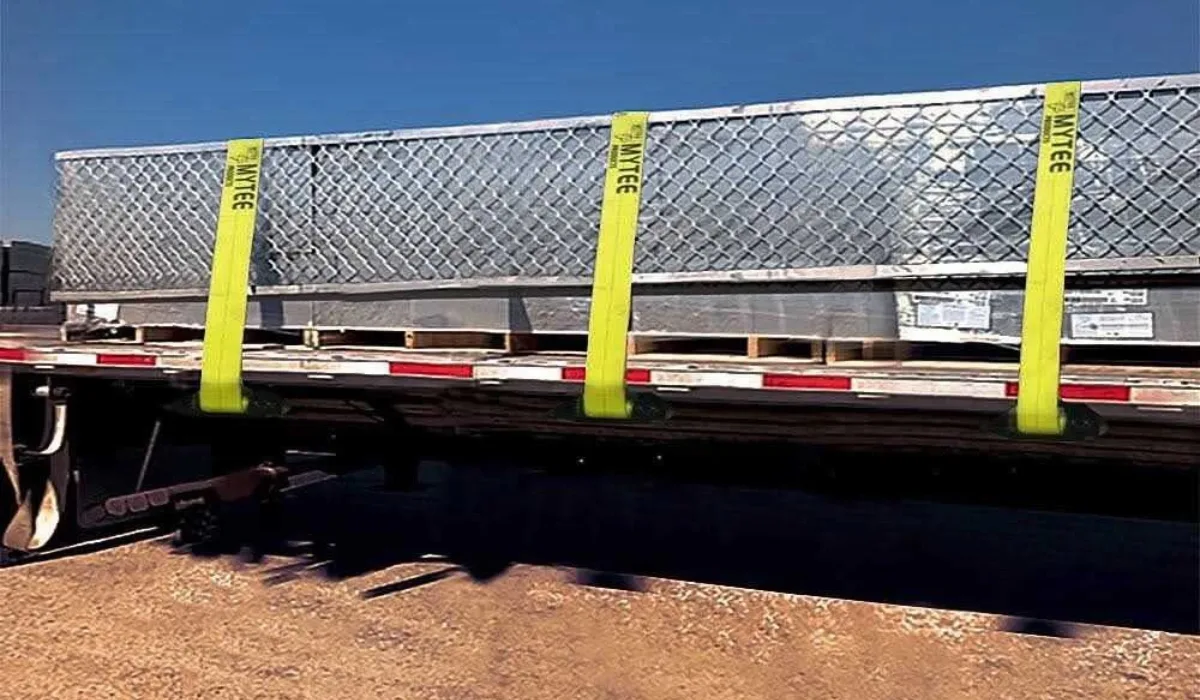
When sideboards are used to contain a load, they are part of the structure holding that load on the truck. In practice, that means two things:
- They need to be strong enough for the job. Dense masonry pushes sideways on every turn, stop, and start.
- They need to be in sound condition. Cracks, bent frames, and loose fit are the kinds of problems the condition rule is concerned with.
Sideboards work alongside tiedowns. They do not replace them. Think of sideboards as what keeps the load from sliding out and tiedowns as what keeps it down.
What to Check on Your Flatbed Sideboards
Structural integrity
Look at the welds at every frame corner for cracks or separation. Press on the center of the mesh. It should not bow or flex noticeably. Check the frame angle along its full length for bends, especially on the bottom edge where forklifts make contact.
Fit and installation
The panel should seat fully in the stake pocket and not rock or shift. Check that all hardware and retention pins are present and not bent or corroded. Gaps between panels, or between a panel and the load, are worth correcting before you leave the yard.
Condition and repairs
Surface oxidation on aluminum is normal and is not the same as structural damage. Cracks, deformed mesh, and buckled frames are structural. If a panel has been repaired, have a qualified welder confirm it is back to sound condition before it returns to service. When in doubt, replace it.
What to avoid
Putting a damaged panel back on the truck because "it held last time." Condition is judged on the day of the inspection, not on the last trip.
Pre-Trip Sideboard Inspection Checklist
Step 1: Walk the full length of the truck, both sides.
- Welds intact at all frame corners, no cracks
- Mesh not bowed, torn, or deformed
- Frame angle and edges straight, with no bent or damaged sections
- Each panel seats fully in its stake pocket and does not rock
- Hardware and retention pins present and in good condition
- Panel height contains the tallest stack in the load, with margin
- No gaps where cargo could slide or fall out
- Tiedowns in place and in good condition
Step 2: Re-examine the load and securement during the trip. The regulations require drivers to check cargo and securement early in a trip and again at set intervals.
In summary
Inspect before you go, re-check on the road, and take damaged equipment out of service.
How Unique Sideboards Are Built
We build every Unique Sideboard as a precision-welded single piece from 5/16" gauge Uni-Mesh aluminum. Each panel is finished with 1/2" U-channel edging and an exclusive 1-1/2" x 5" angle with a radius outer edge.
Here is why those details matter for the points above:
- Single-piece welded construction means there are no bolted joints in the panel to work loose over time.
- Heavy 5/16" gauge mesh is built to resist the sideways pressure of dense masonry loads.
- U-channel edging protects the perimeter of the mesh.
- Aluminum does not rust, and a welded aluminum panel can be repaired when damage is limited to one area.
Want the full picture on materials, sizes, and ordering? See our complete buyer's guide to flatbed sideboards.
Frequently Asked Questions
Are aluminum sideboards DOT compliant?
Material alone does not determine compliance. FMCSA does not approve or certify individual sideboard products. What the rules look at is whether your securement system meets the performance criteria and whether its components are in sound condition. A well-built aluminum panel that is undamaged and properly fitted supports that.
What happens if my sideboards fail a DOT inspection?
It depends on what the inspector finds. Outcomes can include a violation on the driver and carrier record, CSA points, and in serious cases an out-of-service order that keeps the truck from moving until the problem is corrected.
How often should I inspect my flatbed sideboards?
Do a walk-around before every trip, and re-check during the trip as the regulations require. Schedule a closer inspection after any forklift strike or loading incident.
Can I repair a damaged sideboard and keep it in service?
Sometimes. Localized damage on a welded aluminum panel, such as a bent corner angle or a single cracked weld, can often be repaired by a qualified welder. The repaired panel still has to be in sound condition when inspected. If the mesh is deformed over a large area or the frame has buckled, replace it.
Do sideboards replace tiedowns?
No. Sideboards contain the load from the side. Tiedowns hold it down. Use both.
Need sideboards for your fleet?
Tell us about your trucks and your loads. We will recommend the right panels and send a custom quote.